In padel, rackets are changed much more often than people think.
You try a new model.
You want more power.
You switch to a different shape.
Your level improves.
The problem?
Selling one racket to buy another isn’t always simple.
And that’s where trade-in with price adjustment comes into play.
What is trade-in with price adjustment?
It’s a very simple system:
You have a racket.
Another player has a different model.
The two rackets don’t have the same value.
You trade them and adjust the price difference.
Practical example:
Your racket is worth €200
The other one is worth €260
Difference: €60
Whoever receives the lower-value racket pays the difference.
That’s it.
No separate sales.
No double negotiations.
One single operation.
Why does it work better in padel than in other sports?
Padel has a unique characteristic:
Players change rackets much more often than in tennis.
In tennis, a racket can last for years.
In padel:
Models change rapidly
Technologies evolve every season
The average player level grows quickly
Many players are looking for the “perfect racket” for their style.
This creates a dynamic market.
And where there is turnover, trading is natural.
Why is selling first and then buying less efficient?
The classic path is:
I list my racket
I find a buyer
I get paid
I search for a new model
I negotiate with another seller
Double time.
Double risk.
Double negotiation.
With trade-in with price adjustment:
✔ One single operation
✔ One single negotiation
✔ Faster
✔ Smarter
The real psychological advantage
There’s an aspect few consider.
Many players don’t want to “sell.”
They want to improve.
Trade-in with price adjustment is not giving up.
It’s an upgrade.
Mentally, it feels much more natural.
Why it doesn’t work on general marketplaces
Platforms like Vinted or Subito are designed for selling.
Not for structured trading between players with technical evaluations.
Padel is vertical.
It requires a vertical platform.
When should you use trade-in with price adjustment?
When you want to change model
When you want to move up a category
When you want to try a different shape
When you don’t want to lock up cash
It is especially useful in transitions:
Beginner → Intermediate
Intermediate → Advanced
A real example
Marco has been playing with a round racket for 12 months.
He wants more power.
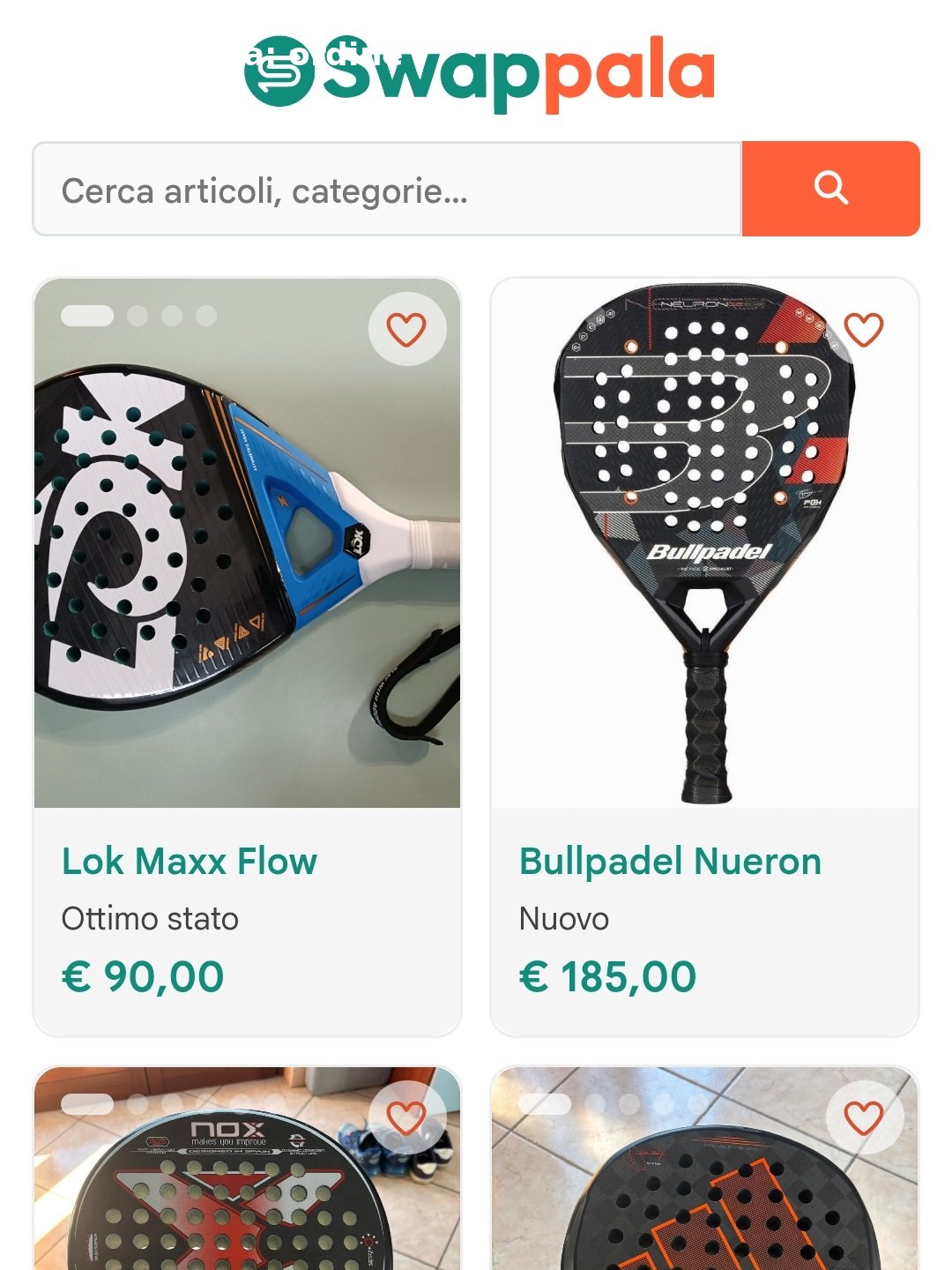
On Swappala, he finds a player using a diamond-shaped racket but looking for more control.
The rackets have different values.
They agree on the difference.
Both improve.
No one has to sell first and then buy.
Padel is the perfect sport for trading
High model turnover
Continuous growth of the average level
Strong community component
Culture of testing and upgrading
Trade-in with price adjustment is not an additional feature.
It is perfectly aligned with the nature of padel.
🔁 Do you have a racket that no longer convinces you?
Don’t leave it in the closet.
Don’t wait to “find the perfect buyer.”
Propose a trade-in with price adjustment on Swappala
and find the model that better fits your game.
👉 List your racket and discover who wants to trade with you.
FAQ
Is trade-in with price adjustment safe?
Yes, when managed on a structured platform it avoids improvised negotiations and unprotected payments.
Can I decide the price difference myself?
The difference is agreed between the parties based on the estimated value of the rackets.
Does it also work for tennis?
Yes, but in padel it is even more effective due to the frequency of equipment changes.